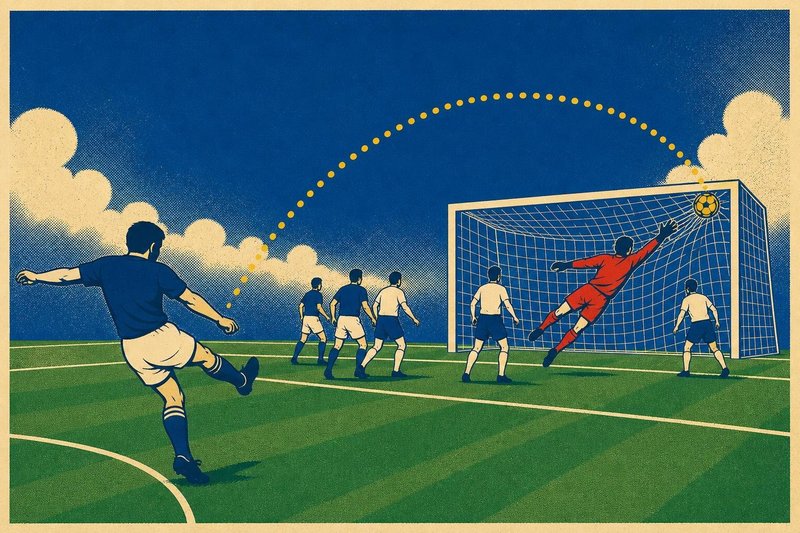
Sidny Lopes Cabral, the newest of the Goal of the Tournament winners, had already beaten Alexis Mac Allister when he looked up. The curler that followed, over Emiliano Martínez and into the far top corner in extra time at Miami Gardens, did not save Cape Verde, who lost 3-2 to Argentina in the round of 32. It did win the vote. Lionel Messi, Kylian Mbappé and Julián Álvarez all had goals on FIFA’s shortlist for 2026, and a 23-year-old defender from Cape Verde beat them.
That pattern runs through the history of the Goal of the Tournament. The award is about one strike, not about who won the trophy, and the winners list is full of players who scored once and went home early.
Every Goal of the Tournament winner, World Cup and EURO
FIFA first put the question to fans after the 2006 World Cup, and Maxi Rodríguez’s extra-time volley for Argentina against Mexico in Leipzig became the first winner. Since then the World Cup award has gone to Diego Forlán (2010), James Rodríguez (2014), Benjamin Pavard (2018), Richarlison (2022) and Cabral (2026). Pavard was the World Cup award’s first European winner; four of the six goals came from South American players.
The EURO has a shorter record. UEFA ran a fans’ poll in 2012, which Zlatan Ibrahimović won with 39.9% for his volley against France. From 2016 the technical observers also rank the best goals, so a tournament can end with two answers. In 2016 fans chose Zoltán Gera’s half-volley for Hungary against Portugal with 32%. In 2024 the observers placed Lamine Yamal’s semi-final goal against France first, while the fans’ vote went to Mert Müldür’s volley for Türkiye against Georgia.
The full list of Goal of the Tournament winners, with match, round and how each goal went in, is on the World Cup and EURO pages.
The best goals, and what they have in common
Look at the winners together and three kinds of goal keep coming back. Volleys, first of all: Maxi Rodríguez, Forlán, James, Ibrahimović and Müldür all hit the ball before it touched the ground. Then acrobatics, Richarlison’s scissor kick against Serbia above all. Then distance, which is where EURO 2020 belongs.
The EURO 2020 Goal of the Tournament went to Patrik Schick, who saw David Marshall off his line in Glasgow and shot from 49.7 yards. Opta recorded it as the longest goal at a European Championship since 1980. Nearly 800,000 votes came in within about a day, and the winner of the EURO 2020 Goal of the Tournament also received a digital trophy, an NFT designed by the artist Pokras Lampas for an official sponsor of that tournament.
What the best goals rarely are is decisive. Forlán’s came in a third-place play-off. Pavard’s equalised in a game France won 4-3, and Cabral’s still ended in defeat. Voters reward the strike itself, and you can usually see why within the first replay.
How the vote works
Both awards start with a shortlist and end with a public vote. FIFA does not publish how its shortlist is drawn up; it said the 2018 list held 18 goals and the 2026 list 12, chosen from 308. UEFA’s observers, a panel of former coaches and players, watch every match and then vote together. The Puskás Award, given every year since 2009, mixes a FIFA Legends panel with fans at equal weight.
There is a separate page on how the vote works, including the 2026 change to round-by-round polls before the final ballot. Of the winners of those phase polls, Erling Haaland’s goal against Brazil took 34% in the round of 16 and still finished behind Cabral at the end.